
People-powered education: How slice teams could transform the Department for Education
I'd love to hear your thoughts on my independent green paper


Over the last few years - twelve, to be precise - I’ve been immersed in a bit of a career side-quest: to help schools get better at implementing change. The resulting Making Change Stick book and implementation system are now being used in schools all over the world, and that is a wonderful thing indeed.
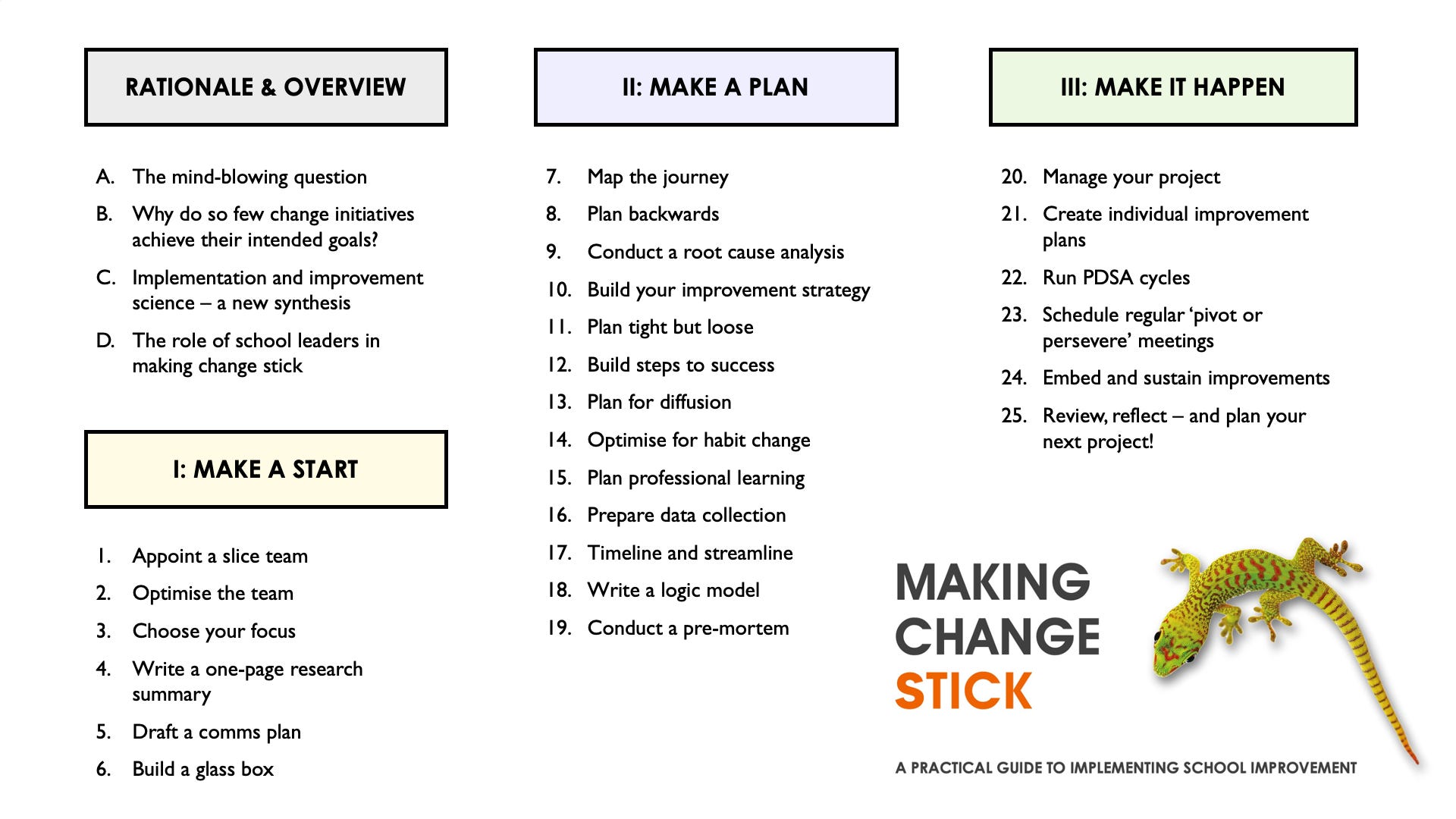
There are loads of brilliant ideas in the Making Change Stick programme - and I can say this in all humility, because very few of them are mine. I simply trawled the change-management literature, magpied a bunch of ingenious tools and strategies, and assembled them into a coherent, three-part programme.
There is, however one big idea that drives the whole approach: the slice team.
A slice team is a small, diverse group of people drawn from every layer of a system and brought together to solve a shared problem. In a school, that might be someone from the senior leadership team, a middle leader, an early career teacher, the SENDCo, a teaching assistant, a member of the site staff - and, where it helps, governors, parents and the children themselves. The principle is simple: whoever has a valid perspective on the problem you’re trying to solve gets a seat at the table.
I’ve watched slice teams transform behaviour, inclusion, culture and teaching in ways that top-down mandates never seem to manage. Slice teams transform the quality of change implementation in two key ways.
You get better decisions. The people closest to the problem expose blind spots, suggest better ideas, and stress-test solutions against the messy reality of a school before anyone commits to anything.
You get buy-in like never before. When staff can see that they’re genuinely represented, they feel seen, heard and respected. Change stops being something done to them and becomes something they’re helping to shape - and so they come with you on the journey. As one school leader, Sean Thomas, put it: “the slice team makes buy-in across the school far more powerful.”
At some point on this journey - actually, more or less every single time I switched on the news - a thought occurred to me that I couldn’t shake…
“What if we had slice politics?”
A few years ago, I sketched out that idea in a TEDx talk called How to Change the World.
Since then, I’ve spent a lot of time thinking it through and refining the model - how it might be applied to a government department, perhaps even across multiple departments.
Today, I’m publishing an independent green paper that takes the idea further. It takes the Department for Education as a worked example and asks a deceptively simple question: what if we ran it like a slice team?
It’s been sitting on my computer for a while, but I’m releasing it now for a reason. Andy Burnham is on the verge of becoming Prime Minister, and he arrives with a clear set of commitments - to education reform, to devolution, and to “rewiring Westminster” and doing politics differently.
This is quite the combination. Applying slice politics to the DfE is, of course, about education reform. It’s also about rewiring Westminster. And - perhaps most intriguingly - it represents a different kind of devolution.
Devolution is usually about geography - drawing power down from London to the regions, mayors and town halls. The instinct is a good one, and slice politics shares it - but takes it a step further.
Rather than simply handing power to whoever happens to control a particular place, slice politics devolves power to the people with the most knowledge, experience and stake in an issue: in this case, the professionals who deliver education, the families and young people who live with its consequences, and the researchers who study it. And it does this while keeping national democratic accountability firmly in place - so the system remains coherent, and children’s entitlements remain consistent, wherever they happen to live.
If an incoming Burnham government is serious about rewiring how Westminster works, the DfE would be a good place to start - changing not just what education policy says and does, but also rethinking how that policy is designed, implemented and evaluated. After all, as the implementation equation goes:
What x How = Wow
I want to be clear about what this green paper is, and what it isn’t. It’s an independent think piece, written to stimulate debate and thinking. I do not present it as the final word on anything. I’m sure there are holes in it, things I’ve missed, and better ways of doing this. That’s kind of the point: no single individual holds all the solutions to complex problems. We need to get in the habit of putting our heads together.
So I’d genuinely love to know what you make of it. The full document is available to download here, and I’ve included the Executive Summary (and a schematic) below to give you a flavour. Please read it, pull it apart, push back on it, tell me what resonates and where you think I’ve got it wrong.
Let’s imagine what a different kind of politics - and a different kind of devolution - might look like.
EXECUTIVE SUMMARY
A moment of opportunity
This paper sets out a bold new approach to how education policy is made, rooted in shared power, systems thinking and democratic participation. It reimagines the policy environment by replacing top-down decision-making with representative, participatory, evidence-informed teams known as slice teams. Each team brings together a diverse mix of people with lived, professional and civic experience of a policy area – including those who work in it, are affected by it, research it or help deliver it.
It is designed to ensure that people throughout the education system – the young people, families and professionals whose lives are most shaped by education policy – are meaningfully involved in how decisions are made, rather than power being confined to a small, unrepresentative group at the centre. Drawing together ideas from systems thinking, implementation science, improvement science and deliberative democracy, it offers a practical framework for effective governance in a complex, dynamic, interconnected system.
For a government serious about education, this is a moment of real opportunity. Trust in top-down reform is low. The system faces deep, interlocking challenges – a Special Educational Needs and Disabilities (SEND) system in crisis, persistent attainment gaps, falling attendance, rising mental health needs, and strains on teacher recruitment and retention. Reforms imposed from Whitehall too often fail to improve outcomes on the ground. Slice politics offers a way to make reform stick: to involve the people who deliver and experience education not as a consultation exercise, but as contributors to how decisions are made.
An operating system for a complex world
The way in which we make education policy is no longer fit for purpose. Decisions are concentrated at the centre, incentives reward short-term thinking, and policymaking is too often shaped by groupthink, churn and crisis management. The result is “initiative-itis” among the teaching profession and a growing sense that policy is done to schools rather than with them.
Slice politics responds to this reality by creating the conditions for ongoing dialogue, data sharing, problem-solving and mutual learning through three interconnected structures:
A horizontal slice team of senior policy leads with substantial experience and deep understanding of particular areas of education – such as SEND, literacy and numeracy, safeguarding or early years – who coordinate strategy and ensure coherence across the system. Instead of relying on a single Secretary of State and a small group of advisers, leadership is shared across this team.
A vertical slice team supporting each policy lead, comprising people with a range of lived, professional and civic experience to shape policy from the ground up.
A lateral slice team connecting each member of a vertical slice team to people in similar roles in different parts of the country, ensuring geographical diversity and a steady flow of locally grounded insight into departmental decision-making.
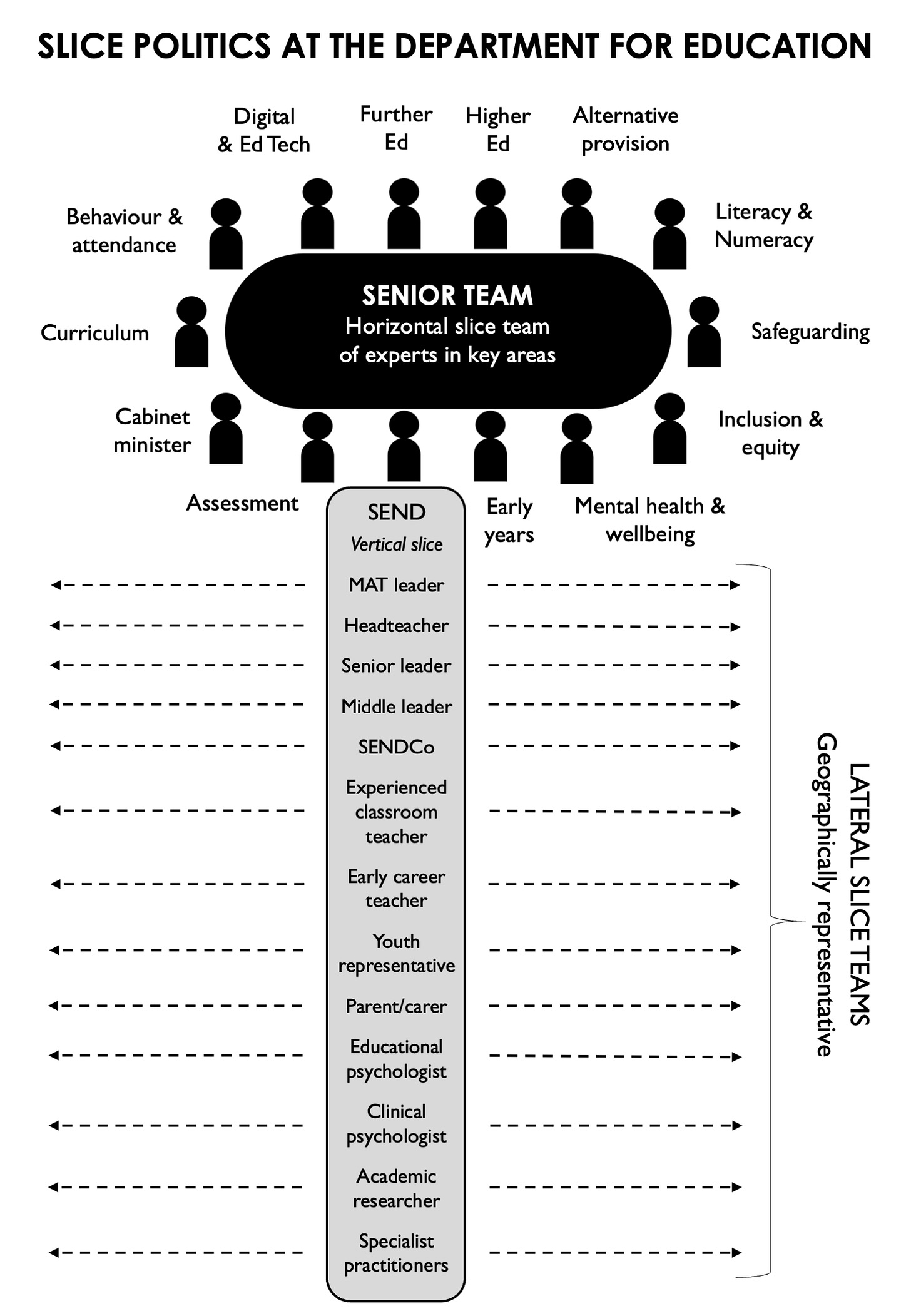
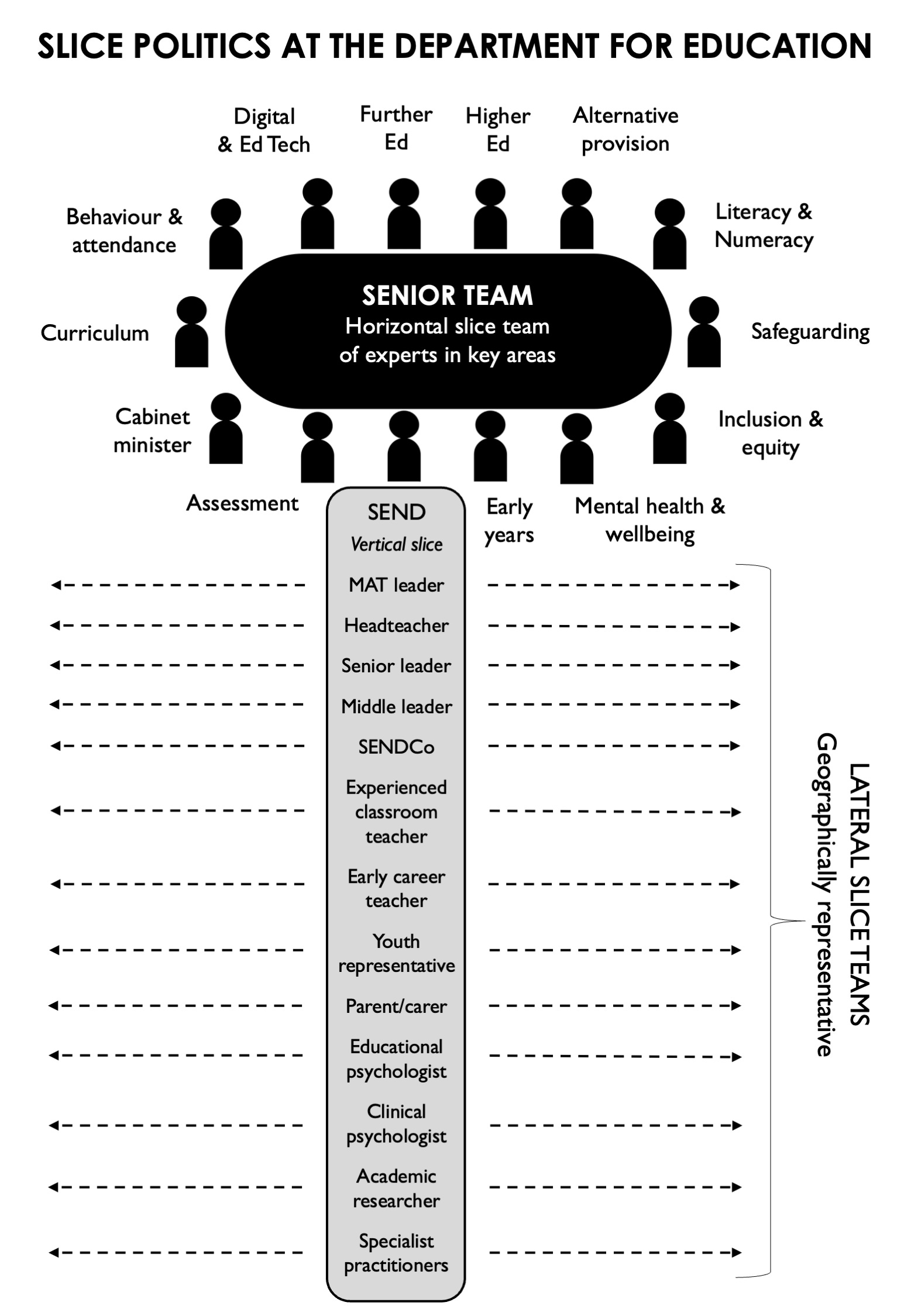
These teams would operate in structured cycles: identifying challenges, co-creating responses, testing them in real-world settings and refining approaches based on a combination of data and ongoing dialogue. Each horizontal slice team would be appointed by – and report to – the Secretary of State, and all teams would be supported by a shared infrastructure for training, logistics and accountability.
The logic is simple – and well evidenced. Across sectors such as health and education, research shows that change driven by representative teams is around five times more likely to take hold and endure than reform imposed from the top. Slice teams bring this proven logic into the heart of national education policymaking.
Why education is the right place to start
Education is among the best-suited areas of public policy for this approach. It is inherently relational and place-based; it depends on a large, skilled and committed professional workforce; it has a strong evidence ecosystem; and it already has rich participatory traditions, from pupil voice and school councils to governing bodies and trust structures. By embedding lived experience alongside professional and research expertise, slice teams ensure that policies are shaped not only by what is politically expedient, but by what is workable, fair, sustainable – and in the interests of current and future generations of children and young people.
For a government wanting to demonstrate that it can govern differently – and implement reforms that last beyond a single ministerial tenure – slice politics offers:
Distinctiveness: a genuinely new operating model for a government department, unlike the conventional machinery of Whitehall.
Credibility: a practical, intuitive model for effective governance that demonstrates seriousness about delivery and responsibility.
Engagement: a way to mobilise the profession, families and young people as active contributors rather than passive recipients of reform.
Durability: a pathway to improved outcomes that is tested, owned, adapted and embedded across the system, rather than imposed and later reversed.
What it would look like at the Department for Education
Under the proposed model, the Department for Education would be organised around slice teams rooted in lived, professional and civic experience from across England. Teams would work alongside civil servants and be accountable to the Secretary of State and Parliament through clear, transparent protocols that strengthen, rather than bypass, democratic accountability. Most slice team members would be based outside London, helping to rebalance the geography of power, supported by a national Slice Office providing coordination, quality assurance and shared learning. This approach would establish a department that tests ideas, learns from experience and governs differently – a model that could, in time, be extended to other government departments.
A different kind of devolution
Slice politics also offers a fresh answer to one of the central questions in British politics: how power should be devolved. Much of the current devolution agenda distributes power geographically, to regions and local authorities – which can leave the direction of education policy, and the entitlements and protections children rely on, to vary considerably from place to place and to shift with changes in local political control.
Slice politics devolves power along a different axis. The model is still spread across the country – its lateral slice teams are geographically representative by design – but power is distributed according to knowledge, experience and stake, rather than handed to whoever controls a particular area. Decisions sit with the people who understand a challenge most deeply and live with its consequences most directly. Crucially, it does so while preserving national democratic accountability and oversight, keeping the system coherent and children’s entitlements consistent even as decisions are brought closer to those they affect.
About this green paper
This paper sets out a practical and hopeful vision for how slice teams could transform the way the Department for Education addresses complex challenges, making policymaking more inclusive, effective and responsive. It also confronts key risks – including bureaucratic friction, representativeness and the potential for capture – and sets out design-based safeguards to mitigate them.
It is written for policymakers, departmental leaders and ministers who want to turn ambition into durable reform; for civil servants, school and college leaders, teachers, researchers and system leaders interested in more effective, participatory forms of decision-making; and for parents, carers, young people and citizens who believe education policy should be made with people, not done to them. It invites policymakers – and any government serious about investing in the education of future generations – to pioneer a model of governance equal to the scale of the challenges we face.
Download the full Green Paper below - and do let me know your thoughts!
